·
11 min
Product marketers: stop tracking how often sales opens your assets. Build an AI agent that compares sales call transcripts with your messaging and shows what lands.

Have you ever been called “soft” before? I have
I have been called many things in my life, but never “soft.” I’ve always carried for a few extra BMI points, so it’s not entirely unlikely someone has at least thought about it. But I have never heard it in the work context.
I was in a meeting with my peers, when the CEO said: "Victor, you're too soft." I was amused as much as I was intent on understanding why.
I had a relationship with him where I took very few things personally. To me, it was more of him making it clear where his bar was, not only to me but to the rest of the team, that you have to go straight through a problem sometimes. There is no time to waste, we were at war in our market!
He was talking about a product release early in my tenure. At that company I worked at, I discovered a misalignment with the product manager. The release itself was cycled between start and stop, and when we finally got to the execution, I think on both sides we felt we had skipped over some critical steps like thinking wide and deep about enabling the sales team.
In normal circumstances, a release as big as the above product release would have gotten a demo certification: we build a demo, the sales reps do the demo, and then they get the feature turned on.
Together, we decided not to run one. If you, my fellow product marketer, have spotted the flaw in my decision, then please subscribe to my blog because you’re someone I’d like to have in my network of stellar folks.
We didn't feel like it was going to be a good use of our time or the sales team's time, and there was this understanding that the onus was on the sales team to get the knowledge they needed to sell the feature.
What I didn't see at the time was that the certification was the signal the sales team needed to feel confident they could pitch this feature. It gave them the permission and the baseline. So while skipping it seemed like me being a helpful colleague, the shadow side was that I was creating ambiguity and more work for them on the other end.
That softness was coming from a place of uncertainty, that I didn't have the right information.
I wasn’t going to let being new to the company and industry be an excuse. So I took it as my imperative to come with insights founded in what was being said in the field: what customers, buyers and our sales team were saying, and how it either drifted from our messaging or supported it. Given my type of personality, I needed that information to have the confidence to really go after things with the sales team.
So, you’ve suffered my story of being called “soft.” What are you going to get out of this blog post?

In this post, I'll share my point of view on sales enablement, then walk you through building an agent that compares what your team says on calls with what your documents say.
I rebuilt it from scratch on a made up company called Rootline, so every finding here is fictional. But the data for Rootline is based on my experience of how B2B software companies of 120 people behave. The agent we’re going to build found insights not dissimilar to the ones I regularly found and leverage to help my previous sales team:
Reps giving a date the roadmap says not to give, in 4 of 11 calls in one week.
The renewal question in the review template, asked in none of the 3 business reviews and renewal calls.
Champions making the case to their board or CFO in 6 of 11 calls, with nothing to hand them.
Please stop counting how many times sales reps open assets. It’s not helping them, you, or the business
If you're a product marketer like me, someone has asked you which assets sales is actually using. Imagine telling your colleagues, "How cool is it that 80% of our sales team is using our pitch deck?" Yeah, like, that's cool, but why does it matter? I guess it means they know where to find your assets, which is a skirmish you’ve probably fought and won.
I think, as marketers, we're trained to go and find information to prove something is happening, or during warm time, to prove that we aren't to blame for a battle lost. The CMO role is one of the most critically evaluated executives in business, Harvard Business Review notes that 80% of CEOs don't trust or are unimpressed by their CMOs, who also have the shortest tenure in the C-suite.
So there can be a culture within marketing teams to cover our asses, and when you're losing business to competitors, it's very tempting to go and look for a reason, any reason that's not you.
Here's the thing: you're not in the client calls, being told no many times a day. If you said something that got a prospect to listen, after many no’s, you sure as hell would say that again the next time too. It's a numbers game, and we're both trying to win.
Yes, it could very much mean that your sales team is simply not using the things you're producing. But that's a much different problem than trying to figure out which assets are being used.
So change it from a sense of ensuring people are doing something to: how do you coach them and direct them in the right direction?
Do you want to sound stupid in front of a stranger? I sure don’t
I’ve shipped a lot of products and features, and the thing I’ve learned about getting messaging to show up in the field on the right comes down to this: the message, the delivery of that message, and how that message is understood by the sales team must all be working in concert.
A slow or complete breakdown of messaging adoption generally comes down to the sales team not feeling confident enough to actually pitch whatever it is.
These are humans at the end of the day. The last thing a salesperson wants to say is "Let me get back to you." It completely stifles their momentum.
So if they really want the deal, they'll ask me, the product manager and maybe a solutions engineer to join the call, and that creates a different issue.
That confidence is exactly what the aforementioned demo certification would have given the team. I didn’t make that mistake again.
The times I've felt that the messaging didn't land were when I didn't take enough time to reflect on the ways I can deliver it: assets, live and offline training, written and verbal, and partnership with sales and product. Is the launch close to the end of the quarter, when the team is in execution mode? Spending the energy looking for reasons why it's not you? Ultimately, that's not a very good use of time.
You want to prove to the sales leader you care about making their team successful
Every Monday morning, I'd bring the head of sales the “sales gem of the week:" what was being said in the field, what they can say to it, and what assets we have to answer it.
Every week I'd also join to do a training on a specific message or feature, framed as "come get what's new, because it's been 6, 9, 12 months."
If you only have 4 crayons, here's a whole pack of new crayons: new language and new capabilities to paint a picture of how the product helps your buyer do their job and get promoted.
You have to know the leader, and you have to know who the leader's trusted allies are: who they give the hardest challenges to, and who they listen to. See your relationship with the head of sales as the fastest way you're going to get feedback on whether something is working in the sales process.
Are you coming with insights that make the other person's job easier, or with problems they have to go do on top of everything else? Come with information that's actionable, and with ownership of what you're going to do about it.
This asset use agent helps you bring those insights to your team.
I promise your asset usage agent will be one of your favorites
At my last company, I built a first version of this: a register of sales assets and a weekly heat map of which ones showed up in call transcripts. What surprised me was reading how prospects were responding to our messaging later in the buying process. Unique selling points we'd talked about at the top of the funnel, like the usability of the tool and the support from our professional services team, became incredibly important when the customer needed to sign on the dotted line.
That gave me an insight into what my backlog should look like: which assets the team needs later in the funnel, what format they take, and what they should say.
Version 2 reads for claims, the individual messages inside each asset, not keywords, with two readers per call and a third agent to settle where they disagree.
This is so important, because it adds an unbiased lens to this work that the first version didn’t have.
It's really here to help you figure out what's being used in the field, where it's being used in the buying process, what's landing, what's not landing, and what's missing.

A quick word before you start: three things to know
You should go try it. But here are three things you need to know.
First, you need your company context files, all the heuristics that are in your head about your business.
Second, this is not an agent you run and then it's done. It requires several stops for you, the human in the middle.
Third, it changes the way you think about sales enablement: less checking who uses what, more knowing what's being said.
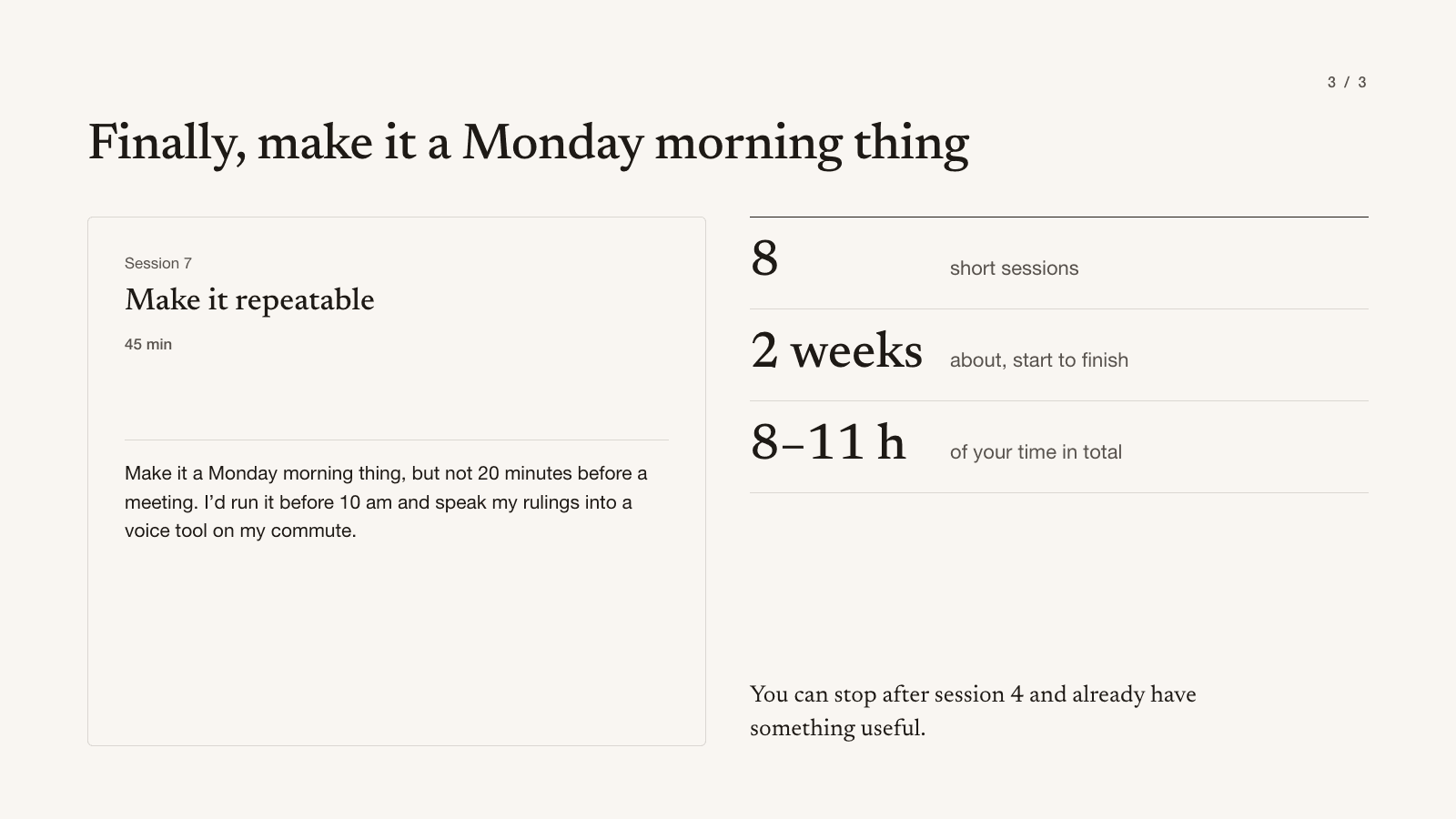
The setup is eight short sessions over about two weeks, 8 to 11 hours in total, and it uses credits, so start small. The kit runs on Claude Sonnet 5.5 at medium effort.


The report is shaped like a pyramid - important, high level information at the tip, deep and wide information at the bottom
For example with the Rootline data I created: After three weeks and 30 calls, the message said most often, in 17 of 30 calls, lived in the customer success documents, not in the positioning document. The headline wasn't said by any rep in any of the three discovery calls. That's what I mean when I say sales isn't ignoring your messaging. They have something that works, and your job is to find it and build on it.

How to bring a finding to sales that doesn’t make you look like a know-it-all (because you actually don’t know it all)
Before you come to them with something they can change to be more successful, you have to understand where they're currently being successful, not only based on the numbers, but how they feel successful.
I really focus on what's going well, because what's not going well is a hard thing to change unless it's critical. If something being said is objectively false, address it very directly. That creates sales debt you have to pay later, and the interest is really expensive. In Rootline, that's the roadmap date from the first finding.
With the head of sales, I'd say something like: "I've observed that our SDRs are pitching our new capability in this way. These are the things that are working really well. Here's where I'd like some tweaks, and I'd like to run a training session at our next weekly session."
Go get the starter kit on Github
The thing I'd really like you to leave with is the sense that you know, so you can be confident you know where you're having an impact. And it's the gaps and patterns that give you the ability to be really supportive to your business, so all the work you're putting into messaging is really showing up in the buying process.
The starter kit is free on GitHub: github.com/vittycent/message-alignment-agent.